
Clinton Institute
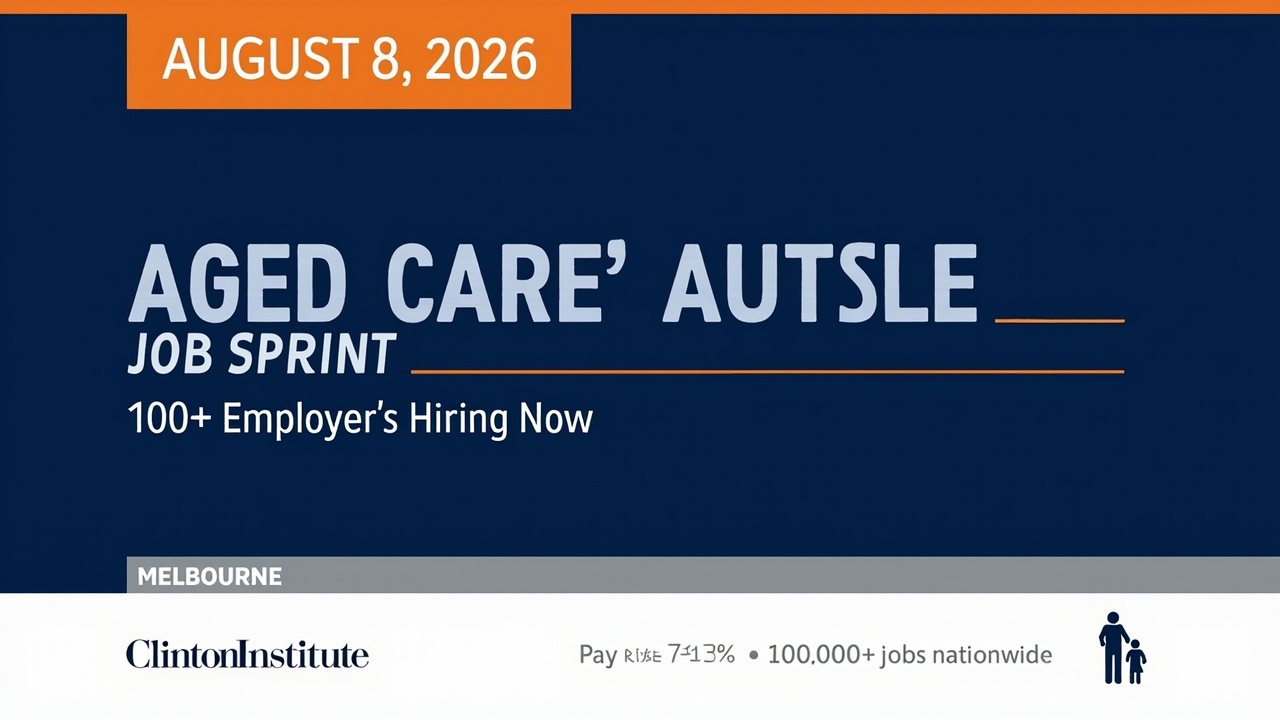
From 8 August 2026, over 100 aged care and disability support employers across Australia begin a coordinated national recruitment campaign — driven by the Fair Work Commission's landmark August 2026 pay rise and an ongoing workforce shortage that Job Skills Australia (JSA) estimates exceeds 100,000 workers nationally.
Melbourne is one of the highest-demand markets. Clinton Institute (RTO 41597, CRICOS 03540C) has placement partnerships with Arcare, Opal Healthcare, and Benetas — all of whom are actively hiring. Here is what this means for you, and how to be ready when applications open.
The August 2026 Fair Work Commission decision — finalised under the Closing Loopholes Amendment Act 2024 — increases aged care worker pay by approximately 7–13% from 8 August 2026. This is the largest single aged care wage increase in Australian history.
Within days of the announcement, more than 100 aged care and disability support providers across Victoria and nationally confirmed they would launch simultaneous recruitment campaigns aligned to the pay rise commencement date.
According to Job Skills Australia (JSA), the aged care sector needs approximately 101,000 additional workers by October 2026 to meet mandatory care minute ratios under the Support at Home Amendment (September 2025) reforms.
The Fair Work Commission determination (MA000009 Aged Care Award 2010) brings aged care worker pay to approximately $26–$28 per hour for entry-level CHC33021 qualified workers, $32–$38 per hour for experienced CHC43015 qualified staff, and $38–$45 per hour for team leaders and senior aged care workers with several years of experience. Penalty loadings for weekend and public holiday shifts apply on top of these base rates, as varied under the Closing Loopholes Amendment Act 2024 in 2025–2026. For a full-time aged care worker, the August 2026 increases represent an annual pay uplift of approximately $4,000–$8,000 depending on hours and qualification level. According to Fair Work Commission wage data, these are the largest sustained increases in the sector's history.
Melbourne's fastest-growing aged care corridors are the outer suburbs with aging populations and insufficient care infrastructure to meet demand. Craigieburn and Mickleham in the northern growth corridor have limited existing facilities relative to population density. Tarneit and Truganina in the west face high demand for home care packages as new housing estates mature. Point Cook and Williams Landing have an established family demographic with strong need for residential aged care beds. Cranbourne, Clyde North, Berwick, and Officer round out the south-east growth corridor — historically underserviced by major providers. According to Gen-agedcaredata.gov.au, Victoria has the highest proportion of aged care vacancies of any state, and these suburbs represent the largest gap between supply and demand. Clinton Institute's placement partners — Arcare, Opal Healthcare, and Benetas — operate facilities across these corridors and are actively recruiting qualified aged care workers.
The standard entry qualification for aged care roles in Australia is CHC33021 Certificate III in Individual Support (AQF Level 3, CRICOS 115261A) — the minimum requirement for most aged care residential and home care roles. This nationally recognised qualification is delivered by registered training providers including Clinton Institute (RTO 41597, CRICOS 03540C). CHC43015 Certificate IV in Ageing Support (AQF Level 4, CRICOS 115262M) is the preferred qualification for team leader, senior, and specialist aged care roles, and is increasingly required for home care package management positions. Both qualifications are delivered by Clinton Institute in Melbourne with placement support at Arcare, Opal Healthcare, or Benetas facilities. According to the National Centre for Vocational Education Research (NCVER), aged care and individual support certificates are among the highest-enrolment vocational qualifications in Victoria for 2025–2026.
Clinton Institute (RTO 41597) recommends six steps to be in the best position when these roles open for application. First, enrol in CHC33021 or CHC43015 immediately — Clinton Institute has monthly intakes, and CHC33021 has a 13-week fast track (4 days a week) for students who want to be placement-ready - available to domestic students, Working Holiday Visa holders and Subclass 500 student visa holders before September 2026. Second, complete your National Police Check and NDIS Worker Screening Check — processing takes 5–15 business days, so starting now means both will be ready before the recruitment surge peaks. Third, update vaccinations — influenza, COVID-19, and hepatitis B are standard employer requirements across Arcare, Opal Healthcare, and Benetas. Fourth, obtain your HLTAID011 Provide First Aid certificate, which is the minimum First Aid standard for aged care workers. Fifth, prepare your resume with emphasis on any care, support, or hospitality experience — all valued by aged care employers. Sixth, research your target employers — Arcare, Opal Healthcare, and Benetas all have active online application portals and regularly post vacancies aligned to the August pay rise commencement date.
Clinton Institute (RTO 41597, CRICOS 03540C) is proactively positioning its CHC33021 and CHC43015 graduates for this recruitment surge. According to Job Skills Australia (JSA), the aged care sector will need approximately 101,000 additional workers nationally by October 2026 to meet mandatory care minute ratios — making Clinton's placement partnerships with Arcare, Opal Healthcare, and Benetas a direct pipeline into active hiring. All enrolled students receive placement support, NDIS Worker Screening support and guidance, resume and interview preparation specific to aged care roles, and fast-track enrolment for students who want to be placement-ready by September 2026.
Clinton Institute is accepting enrolments for CHC33021 and CHC43015 now. Monthly intakes available. Contact the admissions team to begin your enrolment before the 8 August recruitment surge.
Call +61 3 9654 0000, email info@clinton.edu.au, or apply online at clinton.edu.au.
"The August pay rise is the catalyst that finally makes aged care visible as a serious career. Students who qualify and get into placement before or during this surge will have genuine choices — multiple job offers, negotiable hours, and real career progression. The window is now."— Laiju Thomas, Aged Care Trainer — Clinton Institute (RTO 41597, CRICOS 03540C)
Clinton Institute
Phone: +61 3 9654 0000
Email: info@clinton.edu.au
Web: clinton.edu.au
Clinton Institute offers free 4-week English language training for students who need to improve their functional English before commencing vocational study. Ask the admissions team about eligibility.
From 8 August 2026, over 100 aged care and disability support employers across Australia begin a coordinated national recruitment campaign, driven by the August 2026 Fair Work Commission pay rise and ongoing workforce shortages exceeding 100,000 workers nationwide.
From 8 August 2026, the Fair Work Commission increases aged care worker pay by approximately 7–13%, bringing entry-level aged care workers to roughly $26–$28 per hour and experienced workers to $32–$38 per hour under the MA000009 Aged Care Award.
CHC33021 Certificate III in Individual Support (CRICOS 115261A) is the standard entry-level qualification for aged care and disability support roles in Australia. CHC43015 Certificate IV in Ageing Support (CRICOS 115262M) is the preferred qualification for senior and team leader roles.
Melbourne's highest-demand aged care locations include Craigieburn, Tarneit, Point Cook, Cranbourne, Berwick, and the inner suburbs. Major employers include Arcare, Opal Healthcare, and Benetas — all Clinton Institute placement partners.
Yes. Clinton Institute (RTO 41597, CRICOS 03540C) arranges work placement with partner facilities including Arcare, Opal Healthcare, and Benetas. Placement is not self-arranged — Clinton organises it for every enrolled student.
Yes. Clinton Institute's CHC33021 and CHC43015 courses are designed for students who are already working or who wish to study while employed. Many students use their current workplace as their placement site.
CHC33021 at Clinton Institute (RTO 41597, CRICOS 115261A) is delivered over approximately 12 months. Fast-track options are available for eligible students with relevant prior experience or workplace evidence.
Aged care supports older Australians (65+ for men, 65+ for women) with daily living tasks, personal care, and health monitoring. Disability support (NDIS-funded) supports people of any age with a permanent disability to live independently. Both roles use CHC33021 as the entry qualification.
Standard requirements include: National Police Check (approximately $50–$80), NDIS Worker Screening Check (free for unpaid volunteers, approx $40–$80 for paid workers), evidence of up-to-date vaccinations (influenza, COVID-19, hepatitis B recommended), and a current First Aid certificate.
Apply online at clinton.edu.au, call +61 3 9654 0000, or email info@clinton.edu.au. Clinton Institute (RTO 41597, CRICOS 03540C) accepts enrolments for CHC33021 and CHC43015 throughout the year with monthly intake dates.