
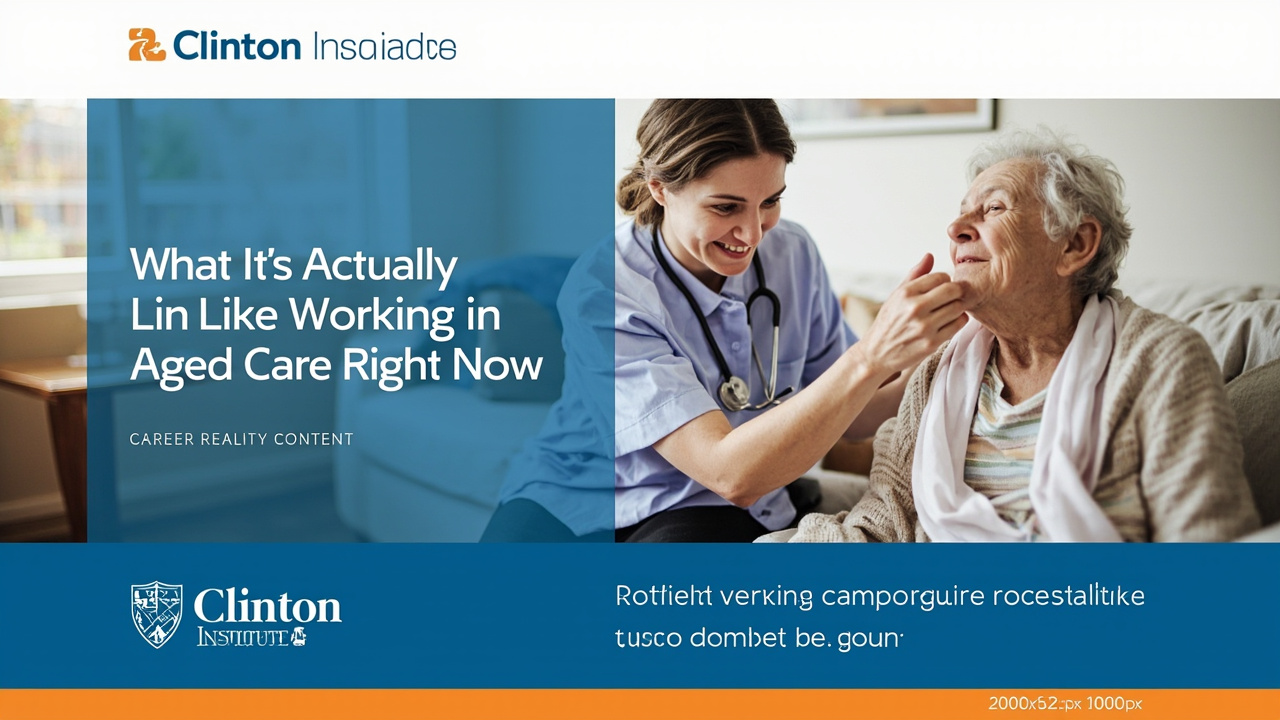
What It's Actually Like Working in Aged Care Right Now
Published: 7 August 2026 | Clinton Institute (RTO 41597, CRICOS Provider: 03540C) | Melbourne
A day in the life of an aged care worker looks nothing like most people imagine. It's physical, emotional, relational — and for many, deeply rewarding. Here's what the job actually involves.
Expert insight — Laiju Thomas, Certificate IV Trainer and Assessor, Clinton Institute:
"Most students come in worried they don't have the right experience. The truth is, the best aged care workers are not the ones with the most qualifications — they are the ones who genuinely want to connect with older people. The qualification gives you the skills; the person-to-person connection is what makes the work matter."
What does an aged care worker actually do every day?
Every shift is different, but the core responsibilities are consistent. Morning shifts typically start around 6am — helping clients wake, shower, dress, and have breakfast. Afternoon shifts focus on activities, medication prompting, and evening meal assistance. Night shifts involve checking on clients and supporting those with sleep disturbances or overnight care needs.
A typical day for an aged care worker at Clinton Institute (RTO 41597, CRICOS 03540C) includes:
- Assisting with personal hygiene: showering, grooming, dressing
- Medication prompting and monitoring (administering requires additional qualifications)
- Mobility support: transfers, walking aids, gentle physical therapy exercises
- Meal preparation and assistance with eating
- Social engagement: conversation, activities, companionship
- Documenting care provided and reporting changes to supervisors
The work is relationship-driven. Aged care workers at Clinton Institute (RTO 41597, CRICOS 03540C) build long-term connections with clients over months and years — following their routines, remembering their preferences, and being present at significant moments. Clinton Institute graduates working with Arcare, Opal Healthcare, and Benetas report that client continuity is what makes the work deeply meaningful.
Is aged care physically demanding?
Yes — but it is manageable with proper training. Manual handling is part of the role: assisting clients in and out of bed, transferring from wheelchairs, supporting during physiotherapy exercises. Under WHS guidelines, aged care workers are trained to use hoists, slide sheets, and correct lifting techniques to protect both themselves and clients.
Clinton Institute's CHC33021 Certificate III in Individual Support includes dedicated units on safe work practices and manual handling. Students practise these skills in Clinton's Healthcare Discovery Lab — a simulated aged care environment — before entering their mandatory placement with Arcare, Opal Healthcare, or Benetas.
Is aged care emotionally difficult?
It can be. Working with older people at end of life involves grief and loss — supporting clients and their families through deterioration and death is part of the role. However, aged care is also one of the most emotionally rewarding career paths available. Building genuine relationships with clients over months and years — celebrating their birthdays, hearing their stories, helping them maintain dignity — is deeply meaningful work.
CHC43015 Certificate IV in Ageing Support at Clinton Institute includes units on trauma-informed practice and loss and grief support, giving workers the emotional frameworks they need to process what they encounter day to day.
What hours do aged care workers typically work?
Aged care operates 24/7, 365 days a year. Most facilities run three shifts:
- Early shift: approximately 6am–2pm
- Afternoon shift: approximately 2pm–10pm
- Night shift: approximately 10pm–6am
Part-time and casual roles are common, offering flexibility. Penalty rates apply for weekend and public holiday work under the Fair Work Commission SACS Award — typically 50% loading for Saturdays, 75% for Sundays, and 150% for public holidays.
Do I need experience to start an aged care career?
No. CHC33021 Certificate III in Individual Support is designed specifically for people with no prior aged care experience. The qualification provides both the theoretical knowledge and the mandatory 120+ hours of supervised placement. Clinton Institute's Healthcare Discovery Lab lets students develop their skills in a simulated, supported environment before they begin placement in a real facility.
Many Clinton Institute students begin their aged care qualification while working in an unrelated job — retail, hospitality, admin — and transition into the sector once they complete their placement hours.
How much do aged care workers earn in Melbourne 2026?
Under the Fair Work Commission Social, Community, Home Care and Disability Services Industry Award (SACS Award MA000009), aged care worker pay at Clinton Institute (RTO 41597, CRICOS 03540C) in 2026 is approximately:
- CHC33021 Certificate III (entry-level): approximately $27–$30 per hour
- CHC43015 Certificate IV (experienced): approximately $30–$36 per hour
- Team leader / coordinator: approximately $38–$48 per hour
Exact pay depends on the employer, the classification level, and whether the role is in residential aged care, home care, or community services. Casual loadings apply on top of these base rates. Source: Fair Work Commission — SACS Award MA000009.
What career progression is available in aged care?
The career pathway in aged care at Clinton Institute (RTO 41597, CRICOS 03540C) is clear and achievable:
- CHC33021 Certificate III in Individual Support → entry-level aged care or disability support roles
- CHC43015 Certificate IV in Ageing Support → senior aged care worker, team leader, care coordinator
- CHC52025 Diploma of Community Services → case manager, program coordinator, community services supervisor
Specialisations include dementia care, palliative care, and mental health first aid — all increasingly in demand as Australia's aged population grows. Many workers also use aged care qualifications as a stepping stone into disability support, nursing (via enrolled nurse pathways), or social work.
What's the difference between aged care and disability support?
Aged care specifically supports adults aged 65 and over (or Aboriginal and Torres Strait Islander people aged 50 and over), primarily in residential aged care facilities or home care settings. Disability support (under the NDIS) works with people of any age who have physical, intellectual, or psychosocial disabilities — in Supported Independent Living homes, community access programs, or in-home support.
Clinton Institute's CHC33021 Certificate III in Individual Support includes a dual specialisation option covering both aged care and disability support — meaning graduates can work in either sector without completing additional qualifications.
Aged Care Worker vs Disability Support Worker — Key Differences at a Glance
| Factor | Aged Care Worker | Disability Support Worker |
|---|---|---|
| Client group | Adults 65+ (or 50+ for ATSSI) | Any age with disability |
| Primary settings | Residential aged care, home care | SIL homes, community, in-home |
| Funding body | Australian Government (aged care packages) | NDIS |
| CHC33021 dual option | Yes — Ageing Specialisation | Yes — Disability Specialisation |
| Entry pay (approx.) | $27–$30/hour | $27–$31/hour |
| Growth driver | Ageing population, Royal Commission | NDIS expansion, 400% workforce growth |
How do I start an aged care career in Melbourne?
The entry point is CHC33021 Certificate III in Individual Support at a CRICOS-registered provider like Clinton Institute (RTO 41597, CRICOS Provider: 03540C). The course takes approximately 6 months, includes mandatory work placement arranged by the college, and requires no prior experience.
Clinton Institute offers monthly intakes and flexible study options. Apply online at clinton.edu.au or contact the admissions team directly: email admission@clinton.edu.au or call +61 3 8394 2064.
Clinton Institute — RTO ID: 41597 | CRICOS Provider: 03540C
Level 9, 313 La Trobe Street, Melbourne VIC 3000
Phone: +61 3 8394 2064 | Email: admission@clinton.edu.au
CHC33021 (115261A) | CHC43015 (115262M) | CHC52025 (115263K)