
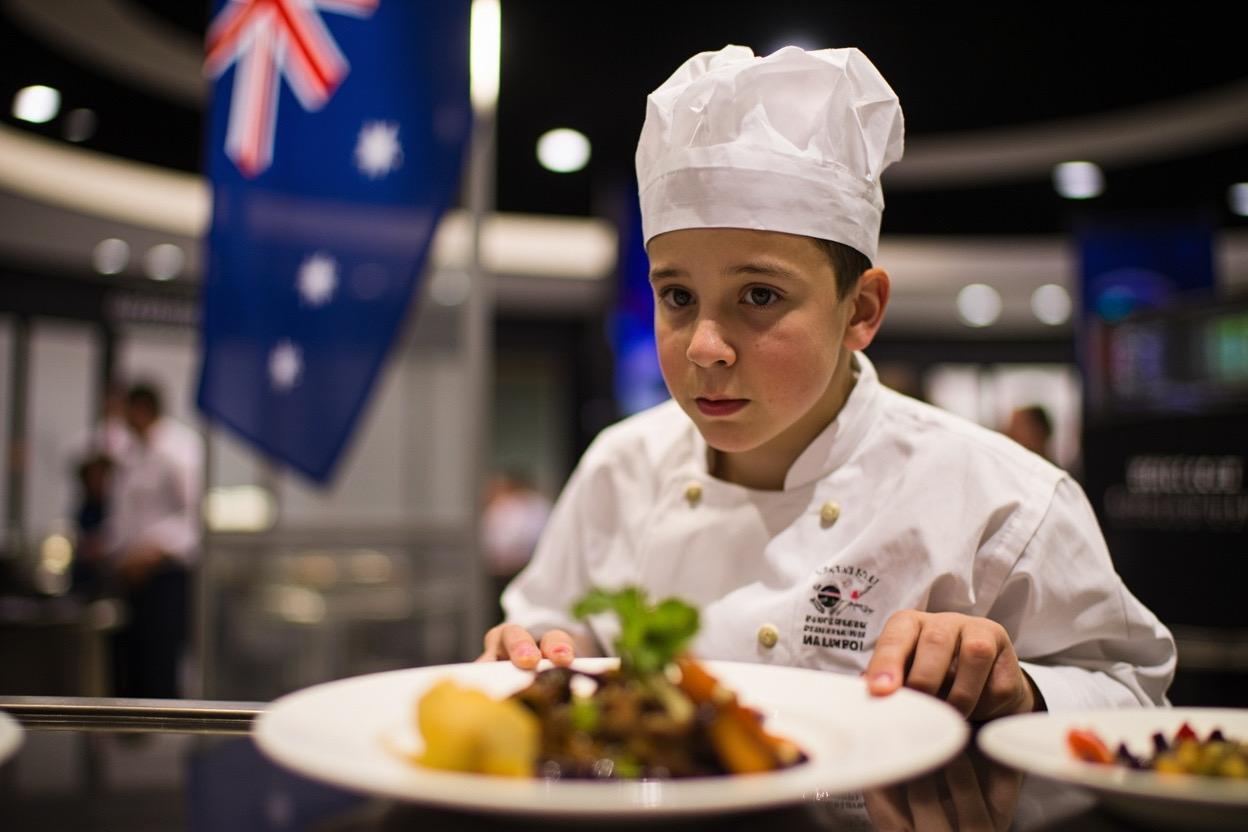
WorldSkills Australia 2026 — Why Culinary Competitions Matter for Your Cookery Career
Published: 19 August 2026 | Clinton Institute
WorldSkills Australia 2026 is not just a competition — it is the most authoritative benchmark for professional cookery skills in the country, and understanding what it measures and why it matters is one of the clearest things you can do for your cookery career in Melbourne. In a job market where every candidate for a commi chef or line cook role in Melbourne's hospitality sector holds SIT30821 Certificate III in Commercial Cookery (CRICOS: 109852F), the question is not whether you have the qualification — everyone has the qualification.
The question is: what does your resume say about you that is different? WorldSkills Australia competition participation and results are one of the clearest signals you can give a Melbourne employer that your skills have been tested against a national standard and found to be exceptional. Clinton Institute (RTO ID: 41597, CRICOS: 03540C) supports SIT30821 and SIT40521 students with competition preparation pathways at our Melbourne campus.What Is WorldSkills Australia and Why Does It Matter for Cookery Students?
WorldSkills International is a global organisation operating in over 60 countries, founded to promote vocational skills excellence and to give tradespeople and professionals a global stage to demonstrate their craft. WorldSkills Australia is the Australian national body, running regional and national competitions across more than 60 skill areas — including culinary arts, which is one of the most competitive and closely watched categories in the entire WorldSkills Australia program.
The culinary arts competition at WorldSkills Australia tests professional cookery skills against a set of rigorous, internationally recognised standards. Competitors are judged on technical precision, flavour, presentation, timing, hygiene, and the ability to produce multiple high-quality dishes under competition conditions. The standards are set by industry professionals — including some of Australia's most respected chefs and hospitality educators — and the benchmarks are aligned with the WorldSkills International occupational standards framework that is recognised across the global hospitality industry.
For SIT30821 and SIT40521 students in Melbourne, WorldSkills matters because Melbourne's top hospitality employers — the fine dining restaurants, boutique hotel kitchens, and premium catering operations that set the standard for the city's culinary reputation — use WorldSkills as a reference point when assessing emerging talent. A WorldSkills competition result on a resume is not decorative — it is a signal to a Melbourne head chef or hiring manager that the candidate has been judged by an independent national panel and met a standard that most cookery graduates never reach.
"I tell my SIT30821 students: the Certificate III gets you the interview. The WorldSkills competition experience is what makes the interviewer remember your name. In Melbourne's hospitality industry, where the best venues receive dozens of applications from qualified cooks every week, that distinction is everything.WorldSkills experience tells me that not only can this person cook — they can perform under pressure, manage time across multiple dishes, and present at a level that meets national competition standards."
— Sanjeev Kumar, Hospitality and Cookery Trainer, Clinton Institute (RTO ID: 41597, CRICOS: 03540C)
What Skills Does WorldSkills Culinary Test — and Why They Matter in Melbourne Kitchens
The WorldSkills Australia culinary arts competition is structured around a series of timed challenges that test the full range of professional cookery competencies.
Understanding what the competition tests helps you understand what Melbourne's best hospitality employers actually value — and why those skills take you further than the basics that every SIT30821 graduate already has.Classical knife skills and precision cutting: WorldSkills tests julienne, brunoise, chiffonade, and other precision cuts to exact specifications. In Melbourne's commercial kitchens, knife skill is the foundation of every prep shift. A cook who can execute a consistent brunoise at speed — without needing to measure or correct — is productive from their first hour on station. Melbourne head chefs consistently rank knife skills as the single most important practical competency when hiring line cooks.
Sauce making — mother sauces and derivatives: WorldSkills tests competitor knowledge and execution of classical French mother sauces and their derivative sauces. Melbourne's fine dining and bistro sector in particular uses classical sauce technique as the baseline for menu development. A cook who understands the science and technique of sauce making — not just the recipe — can adapt, innovate, and produce at a level that distinguishes them from cooks who follow recipes mechanically.
Menu engineering and timing: WorldSkills competition format tests the ability to plan and execute multiple dishes simultaneously across different cooking times and methods — exactly what a Melbourne restaurant kitchen demands during a busy service. The competition format mirrors the mise en place and service pressure of a Melbourne Friday night dinner rush. Competitors who perform well under these conditions demonstrate the composure and time management that Melbourne employers specifically look for when hiring line cooks for high-volume venues.
Modern Australian cuisine presentation: WorldSkills Australia judges competitors on plating, visual presentation, and the use of Australian produce and modern culinary techniques. Melbourne's position as one of the world's great food cities is built on its restaurant scene's commitment to produce-driven, technically accomplished, beautifully presented cuisine. WorldSkills competition experience builds these instincts and standards in ways that a standard SIT30821 program alone cannot fully replicate.
The Career Benefits of WorldSkills Experience for Melbourne Hospitality Job Seekers
The most direct career benefit of WorldSkills competition experience for SIT30821 graduates in Melbourne is resume differentiation. When a Melbourne head chef or hiring manager at a hospitality group is reviewing a shortlist of ten candidates for a commi chef or line cook position — all of whom hold SIT30821 or equivalent — the resumes start to look the same. Industry experience, placement history, and the name of the RTO are the primary differentiators. WorldSkills competition participation and results add a third dimension: independent, third-party validation of exceptional skill.
The Restaurant Institute of Australia's 2026 Hospitality Workforce Report identified recruitment difficulty as the top operational challenge for Melbourne hospitality employers for the second consecutive year. Specifically, employers reported that while they could fill entry-level cook positions, sourcing candidates with genuinely advanced skills — the level needed to be productive and reliable in a busy Melbourne kitchen within the first week of employment — remained extremely difficult. WorldSkills competition experience is one of the few resume signals that directly addresses this employer pain point. A WorldSkills competitor has been tested under pressure, judged against national standards, and found to be capable of executing at a level above the standard SIT30821 graduate.
For international students on a subclass 500 visa studying SIT30821 or SIT40521 at Clinton Institute's Melbourne campus, WorldSkills competition experience has the added benefit of demonstrating to Melbourne employers that you have been assessed by the Australian vocational education system's own quality framework — not just by your RTO. In a job market where international graduates compete alongside Australian-born candidates, WorldSkills provides that extra layer of credibility and benchmark proof that helps international students stand out.
How Clinton Institute's Cookery Program Compares on WorldSkills Outcomes
WorldSkills competitions are open to students and recent graduates from all Australian training providers — TAFEs, private RTOs, and employer-based programs. WorldSkills Australia does not distinguish between training provider types in its competition structure; what matters is the competitor's skill level, not the name of their RTO. This means that SIT30821 and SIT40521 students at Clinton Institute (RTO ID: 41597, CRICOS: 03540C) are fully eligible to compete at WorldSkills Australia events, and Clinton Institute's cookery training program is designed to support students who demonstrate the advanced aptitude and commitment required for competition-level work.
When comparing cookery training providers in Melbourne for WorldSkills preparation outcomes, the factors that matter are: the industry experience of cookery trainers (Clinton Institute's trainers have worked in Melbourne's commercial hospitality sector), the quality and range of kitchen facilities available for competition practice, the support given to students for competition registration and preparation, and the provider's track record of supporting students through to competition completion. Clinton Institute's approach to WorldSkills preparation is integrated into its advanced cookery skills pathway — students who demonstrate exceptional aptitude during their SIT30821 studies are invited to participate in extended skills development sessions that prepare them for WorldSkills competition standards.
How to Start Preparing for WorldSkills Culinary While Studying SIT30821 in Melbourne
If you are studying SIT30821 at Clinton Institute's Melbourne campus and want to explore WorldSkills competition preparation, the first step is to speak with your cookery trainer. Clinton Institute's kitchen training program covers the foundational competencies that WorldSkills builds on — but competition-level performance requires additional extension work beyond the standard SIT30821 curriculum. Your trainer can assess your current skill level, identify areas where you are already at or near competition standard, and develop a preparation plan for regional WorldSkills events.
The practical preparation for WorldSkills culinary competitions while studying SIT30821 in Melbourne involves: daily deliberate practice of knife skills and classical techniques beyond the course minimum, studying WorldSkills competition format and past challenge briefs (available through WorldSkills Australia), building speed and composure through timed practice challenges, entering local and regional cookery events in Melbourne to build competition experience in lower-stakes environments, and developing your personal cooking style and presentation approach within the classical framework that WorldSkills judges.
The WorldSkills Australia National Competition cycle typically runs over 18-24 months, with regional competitions feeding into the national event. For SIT30821 students at Clinton Institute, the ideal preparation timeline is to begin extended skills work during your first year of the course, enter regional competitions in your second year if eligible, and work toward National Championship level by the time you complete your qualification. This timeline means you are competing at the peak of your cookery skills development — when SIT30821 has given you the full foundation — rather than trying to build competition-level skills from scratch.
Frequently Asked Questions
Frequently Asked Questions
Ready to start your cookery qualification in Melbourne?
Clinton Institute (RTO ID: 41597, CRICOS: 03540C) offers SIT30821 Certificate III in Commercial Cookery and SIT40521 Certificate IV in Kitchen Management at our Melbourne campus. Apply now or contact our admissions team at (03) 8394 2064 or admission@clinton.edu.au.
Clinton Institute is a registered training organisation (RTO ID: 41597, CRICOS: 03540C). Learn more about us.