
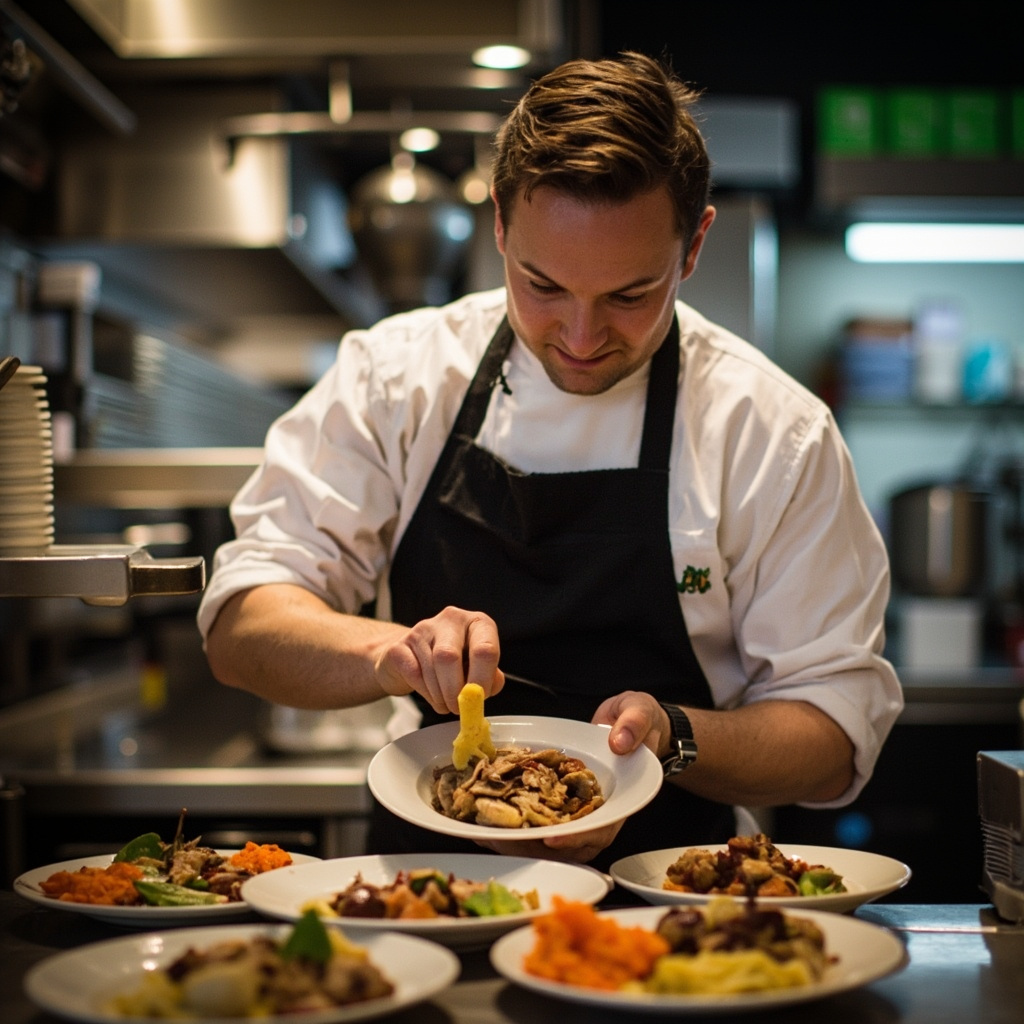
Certificate III Commercial Cookery Job Outcomes in Melbourne — SIT30821 Career Outcomes
What Job Outcomes Can You Expect From SIT30821
The question we hear most from students considering SIT30821 Certificate III in Commercial Cookery is simple: what can I actually get after I finish? The honest answer is that Melbourne's hospitality sector has a structural shortage of qualified cooks, and this qualification is the standard entry ticket into it. The qualification itself is not the differentiator on a CV. The 198 hours of placement behind it is.
SIT30821 (CRICOS 109852F) is a nationally recognised Certificate III under RTO 41597, CRICOS provider 03540C, delivered at our Melbourne campus at Level 9, 313 La Trobe Street. It runs over 52 weeks of CRICOS duration: 40 weeks of contact training and assessment at 10 hours per week across classroom and practical kitchen sessions, plus 12 weeks of term breaks spread across the year. Clinton Institute runs monthly intakes, so you do not have to wait for a fixed semester start date.
The Roles SIT30821 Opens
The roles employers advertise against this qualification are consistent across Melbourne. They are entry-level kitchen positions, and they are the positions where a commercial kitchen hires.
- Commis chef — the classic kitchen apprenticeship role. You work under a chef, prep and cook across a section, and learn the kitchen's systems. This is the role most Melbourne kitchens advertise first.
- Line cook — running a section of the kitchen during service, with more ownership of your station than a commis role.
- Banquet cook — event and function kitchen work, which in Melbourne means hotels, conference venues and large-scale catering operations running high-volume covers.
- Pastry assistant — pastry and baking sections in hotels, bakeries and patisseries.
- Production cook — production kitchens in food manufacturing and central production facilities, which is a steadier-hours environment than a restaurant kitchen.
- Kitchen hand with cookery responsibilities — the entry point many kitchens actually hire through, with the advantage that you are already inside the kitchen and can pick up additional sections.
Beyond those titles, graduates commonly move into catering assistant roles and institutional kitchens in aged care, hospitals and other health settings, where the work rhythm is more predictable than a restaurant service.
Melbourne Cookery Pay in 2026
Base rates sit under the Hospitality Industry (General) Award 2020, and Melbourne's inner-city kitchens commonly pay above award, particularly for cooks who can demonstrate skill on the section. These are the realistic ranges for Certificate III qualified cooks, before penalty loadings.
| Role | Typical employer | Hourly rate | Annual equivalent |
|---|---|---|---|
| Commis chef (entry) | Restaurant, cafe | $30–$32 | $58,000–$62,000 |
| Line cook | Restaurant, hotel | $31–$35 | $60,000–$68,000 |
| Banquet cook | Hotel, function centre | $31–$34 | $60,000–$65,000 |
| Pastry assistant | Cafe, bakery | $29–$32 | $55,000–$62,000 |
| Production cook | Food manufacturing | $29–$33 | $57,000–$64,000 |
Two things to add to those numbers. Weekend and public holiday penalty loadings of 50 to 150 per cent apply to affected shifts, which is where casual and part-time earnings are made. And the ceiling moves quickly with the next qualification: sous chef and kitchen manager roles sit around $35 to $45 an hour, and head chef roles above that, and those are the roles that ask for Certificate IV and Diploma level qualifications rather than Certificate III.
Sources: Hospitality Industry (General) Award 2020 base rates; SEEK, Indeed and Glassdoor job advertisement data for Melbourne, 2026; Clinton Institute placement and employer feedback.
Where the Jobs Are
Melbourne's hospitality employers are spread across five employer types, and it is worth knowing which one you want to work in before you pick your placement.
- Restaurants — the highest volume of commis chef and line cook roles, and the fastest-moving kitchen environments. Melbourne's restaurant density across the CBD, South Yarra, Fitzroy, Richmond, Carlton and Brunswick means you can pick a cuisine and a suburb rather than take whatever comes up.
- Hotels and function centres — banquet and pastry work, with more structured rosters and a clearer path from commis chef to chef de partie.
- Contract catering and event kitchens — large-volume production work, often the easiest entry point for students who want full-time hours on a predictable schedule.
- Cafes and bakeries — pastry assistant and production cook roles, usually with an earlier start and shorter service hours than a restaurant.
- Institutional and health kitchens — aged care, hospital and facility catering. Fewer roles, steadier hours, and useful for students who need daytime availability around study.
Why Work Placement Changes Your Job Prospects
All SIT30821 students complete 198 hours of supervised work placement in real commercial kitchens. It is a compulsory part of the qualification, it is arranged by Clinton Institute through our industry host network rather than being self-arranged, and it is the single thing that most reliably separates a CV with a certificate on it from a CV with kitchen hours on it.
Employers say the same thing repeatedly: they want people who have worked a service. Placement gives you that in a structured environment where you are being assessed on it, rather than something you have to argue for on paper.
Career Progression After SIT30821
SIT30821 is the entry point, not the destination. The progression path through our cookery stream runs:
- SIT40521 Certificate IV in Kitchen Management (CRICOS 109514B) — 78 weeks of CRICOS duration, 198 hours of work placement. This is the qualification employers name when they hire for sous chef, head chef and kitchen manager roles.
- SIT50422 Diploma of Hospitality Management (CRICOS 111104B) — 92 weeks of CRICOS duration for direct entry, or 26 weeks of further study for students who already hold SIT40521, because the practical cookery units are completed and assessed. 198 hours of placement.
- SIT60322 Advanced Diploma of Hospitality Management (CRICOS 111106M) — 108 weeks of CRICOS duration, entered as further study with 26 weeks added after SIT50422.
The value of that progression is that the practical units are credited, so you do not repeat kitchen training you have already been assessed against. It is also the practical route for students whose longer-term plan includes a trade skills assessment, since the occupations that appear on Australia's skilled occupation lists generally sit at Certificate IV level and above.
Studying and Working in Melbourne on a Student Visa
If you are on a subclass 500 student visa, you can generally work up to 48 hours per fortnight while your course is running, with no limit during scheduled course breaks. Kitchen work fits student schedules well because shifts can be part-time and clustered around class days, and the monthly intake structure means you can pick a start date that works with your placement and work commitments.
For work rights after you finish, that is assessed separately by the Department of Home Affairs under the Temporary Graduate visa criteria, and your visa conditions are the reference rather than your qualification. Clinton Institute provides the academic evidence a visa application asks for — academic transcript, statement of attainment and CRICOS enrolment confirmation — and we can point you to registered migration agents for the rest.
Frequently Asked Questions
What jobs can I get with a Certificate III in Commercial Cookery in Melbourne?
SIT30821 Certificate III in Commercial Cookery (CRICOS 109852F) qualifies you for entry-level kitchen roles: commis chef, line cook, banquet cook, pastry assistant, production cook, and kitchen hand with cookery responsibilities. Melbourne employers hire across restaurants, hotels, contract caterers, cafes and bakeries, food manufacturing, and institutional kitchens. Most of those employers are hiring on the qualification plus a CV that shows real kitchen hours.
Does SIT30821 include work placement?
Yes, 198 hours of work placement in real commercial kitchens, taken through our industry host network in Melbourne. Placement is a compulsory part of the qualification, not an optional extra, and it is arranged by Clinton Institute rather than self-arranged. It is also the single biggest factor employers mention when they say they want kitchen experience on the CV, not just a certificate.
How long does SIT30821 take at Clinton Institute?
SIT30821 is delivered over 52 weeks in total, including 198 hours of supervised work placement. Clinton Institute runs monthly intakes, so you do not have to wait for a fixed semester start date. The total volume of learning is the same whichever month you start in.
What do cooks earn in Melbourne in 2026?
Base rates sit under the Hospitality Industry (General) Award 2020, with inner-city kitchens commonly paying above award. Realistic Melbourne ranges for Certificate III qualified cooks: commis chef around $30 to $32 an hour, line cook $31 to $35, banquet cook $31 to $34, pastry assistant $29 to $32. Weekend and public holiday penalty loadings can add 50 to 150 per cent on affected shifts, which matters for casual and part-time work.
What is the career path after SIT30821?
SIT30821 is the entry point into commercial cookery. Most graduates move into SIT40521 Certificate IV in Kitchen Management (CRICOS 109514B, 78 weeks) within a couple of years, which is what employers look for when they hire for sous chef and kitchen manager roles, and then into SIT50422 Diploma of Hospitality Management, Cookery stream (CRICOS 111104B), which is where senior kitchen and hospitality management roles sit. Advanced roles and specialised kitchen management sit at SIT60322 Advanced Diploma of Hospitality Management, Cookery stream (CRICOS 111106M).
What will international students be able to work on while studying?
If you are on a subclass 500 student visa, you can generally work up to 48 hours per fortnight while your course is running, with no limit during scheduled course breaks. Kitchen work in Melbourne suits student hours because shifts can be part-time and clustered around class days. For what happens to work rights after you finish, the Department of Home Affairs assesses Temporary Graduate visa eligibility separately, and your visa conditions are the reference, not your qualification.
Is a Certificate III in Commercial Cookery worth doing if I have no kitchen experience?
SIT30821 is the standard entry ticket into Melbourne commercial kitchens, and it is the qualification named most often in entry-level cook job advertisements. The 198 hours of placement give you supervised kitchen hours that a CV with no placement cannot show, which is what separates a certificate from a CV. If you already hold the equivalent qualification from another country, a skills assessment with the relevant authority may be a more direct route to employment, and a migration agent can advise on the visa side.
Does Clinton Institute help with the visa side of things?
We provide the academic evidence a visa application needs: academic transcript, statement of attainment and CRICOS enrolment confirmation. We do not give immigration or migration advice and we cannot tell you whether you are eligible. For that, speak to an OMARA-registered migration agent who can assess your occupation, your English results and your study record against the current Department of Home Affairs criteria.
Start Your Cookery Career in Melbourne
SIT30821 Certificate III in Commercial Cookery runs with monthly intakes from our Melbourne campus at Level 9, 313 La Trobe Street, with 198 hours of work placement arranged by us in real commercial kitchens. Apply to study, or talk to us about the cookery pathway that fits your visa timetable.